Contact us

Reporting from: https://exhibits.library.cornell.edu/fellow-travelers/feature/education

Education

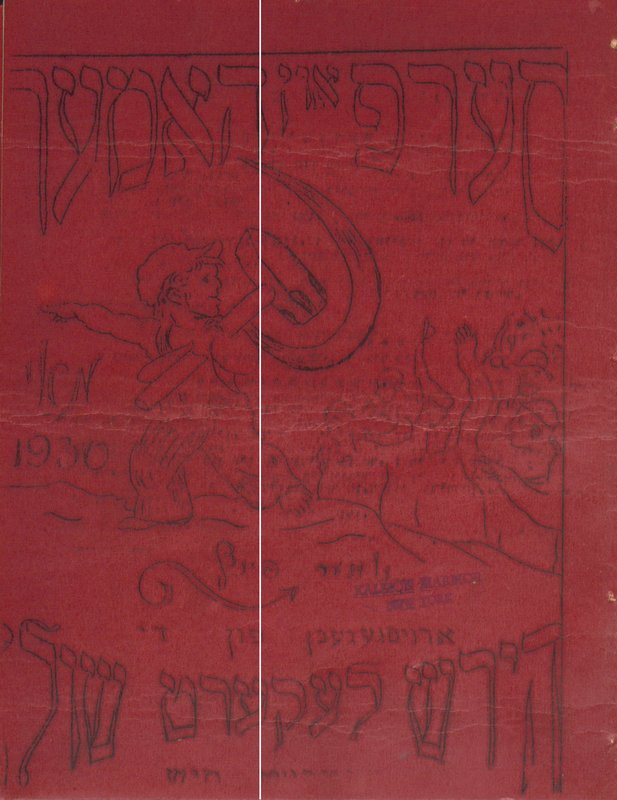
Leftist adult worker education was a priority for the IWO which provided linguistic, cultural, labor, political, musical, theatrical and broader resources: the IWO’s Jewish Section ran a Jewish Workers University and an affiliated theatre company in Yiddish. Other IWO sections were also focused on providing educational resources combined with recreation. The Jewish Section had a large publishing house that published Yiddish classics as well as modernist literature, children's books, and publications such as Yidishe Kultur [Yiddish Culture], and Yungvarg [Youth]. The first secular shule (Yiddish children’s after school) was founded by Dr. Chaim Zhitlowsky for Linke Poale Tsiyon (Left Workers of Zion) in 1910 in the Lower East Side. Zhitlowsky famously combined socialism with Jewish nationalism and was drawn into the IWO world in the 1930s; he died giving lectures on an IWO Canadian wartime fundraising tour. Some children’s magazines from early Arbeter Ring [Workmen’s (Workers) Circle] shules were kept in the IWO’s archives due to its historical overlap with that organization. Umparteishe (non-aligned) shules emerged in the mid-1920s typically joining an extensive IWO shule network that offered elementary school to advanced high school level classes. The earliest IWO shule magazines were radical and lively.

Ten Years of the Jewish Workers University


Notably the IWO published Fraternal Outlook in all its languages using English as its lingua franca to publish the song Strange Fruit about lynching as well as dental and chess columns. Sections, city groupings, and many lodges published newspapers and newsletters, and held lectures as well as published anti-fascist, anti-racist literature. IWO publications in English included New Order Magazine published by its Youth Section; youth from its various sections were introduced to each other through sports leagues, music and other activities. The IWO's work in Chicago included the Abraham Lincoln School and its own Du Sable community center to promote the education and unionization of Black workers as well as community activities.


Dr. Chaim Zhitlowsky Yiddish double bill poster in Boyle Heights, Los Angeles. January 1st, 1942, New Year's Chanukah (Khanike, Hanukkah) themed Childrens' Concert accompanied by a lecture

Los Angeles Yiddish poster of Dr. Chaim Zhitlowsky for a New Year's talk and childrens' concert in Boyle Heights at 2706 Brooklyn Avenue, on Thursday, January 1st, New Years 1942, 2:30pm. The poster graphic features a large picture of Dr. Zhitlowsky with a program that features Sholem Aleichem's Freylekhe Kabtsonim, a Kinder Choir, Chanukah (Khanike, Hanukkah) numbers, and Dr. Zhitlowsky who will appear as a speaker. Boyle Heights was a very active area for the Jewish American Section of the IWO (JPFO). The concert and talk are prior to Dr. Zhitlowsky embarking on a 1943 fund-raising tour for the War effort in Canada where he passed away on tour.

In Yiddish (with Zog Nit Keyn Mol translated into English). 16 pages. Translated Summary: A speaker's guide with program materials. Contains songs and poems, an account of the Ghetto and of the 1942 uprising. Also includes a description (p.10-11) of the rebuilding of the Jewish community in Poland, including descriptions of economic activity, Jewish schools, theater, and periodical publications, housing and other relief efforts coordinated by the Central Committee of Jews in Poland (CKŻP, Centralny Komitet Żydów w Polsce). Includes Binem Heller’s poem "In the Warsaw Ghetto, it is now the month of Nissan." While the Warsaw Ghetto Uprising was downplayed by the Polish and Russian Communist Parties after World War II, its remembrance and commemoration was central to the JPFO's work in the U.S. and in Poland. Cover illustration by William Gropper of Nazi troops shooting Jewish men, women and children fighting with only thrown objects. This copy is different from the related item in that it has the Zog Nit Keynmol songsheet, the booklet is [sparsely] marked up in red to indicate sections included, excluded or emphasized in its use, and the cover is dated April, 1947.
In Remembrance of the Warsaw Ghetto: Program and Materials
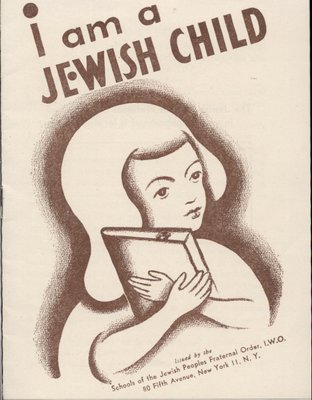
Bilingual Pamphlet. Translated Summary: Argues for attendance in a Jewish school (after-School) as a way of instilling and securing a positive and "progressive" Jewish identity as well as "better prepared for his life as an American Jew." Describes JPFO curriculum which includes Jewish History; Jews the World Over; Yiddish Language (and for the older children, Hebrew); Yiddish Literature; Singing; Dancing and Art; and Social Consciousness. Describes teaching about Asser Levy with an illustration of patriots during the American Revolution. A map of Jews the world over includes workers and farmers in the Soviet Union, Palestine (Eretz Israel), with different imagery for Poland, and France. A page is devoted to Camp Kinderland. Itche Goldberg most probably "delegated, dictated, and rewrote" this brochure with its post-War themes; a curricula influence from Morris Schappes is also evident.
I am a Jewish Child
Anti-Fascist, anti-Muscolini, anti-Nazi literature by Louis Candela head of Italian IWO section which is listed as having 7,000 members. Booklet in Italian asks "Are We Arayans?" Denounces anti-semitism as racist (and non-Italian) and explicitly mentions New York Mayor LaGuardia's mother Irene Coen Lazatti as Italian Jewish. Cover graphic by Perlin.
Siamo Ariani? We are Aryans?
Confirmation Letter circa July 1945 from A .D. Winspear for IWO members attending the Abraham Lincoln School Summer Institute Madison, Wisconsin program organized by Louise Thompson Patterson and William "Pat" Patterson. Winspear notes that ration books are required; World War II has not yet ended. While union members were invited to the Institute each summer, this was the first program geared for Black workers, specifically for members and families of Chicago's Du Sable Lodge 751 and tailored to support IWO goals in organizing in the Black community. Recreation was built into the IWO subsidized program as was childcare. William Patterson and IWO leaders gave classes and/or spoke at the Institute. With the advent of the Cold War, the Pattersons' and the IWO's politics were attacked as were those of the Abraham Lincoln School; its founders A.D. Winspear and William Patterson, and spouse Louise Thompson Patterson were key Lincoln School figures. The program was brought together by IWO Vice President and President of the Illinois District, Louise Thompson Patterson who organized the Chicago IWO Du Sable Lodge.
Abraham Lincoln School 1945 A.D. Winspear confirmation letter to students
Translated Summary: Text of a talk. Begins with humorous comments about the "donor-dinner". Talk focuses on the importance of the schools for the continuity of the culture and the people. Resistance to enemies from without and culturelessness and assimilation from within. Ends quoting a poem by Yehoash. Addressed to mothers and grandmothers in Detroit, so probably a Women's Club precursor of the Emmas. Interesting language choices and essence of ideology
Talk on the Importance of the Schools

About 10,000 pages of documents from the Kheel Center’s collection of International Workers’ Order records have been digitized. You can find more of these documents here along with the full version of documents provided here.