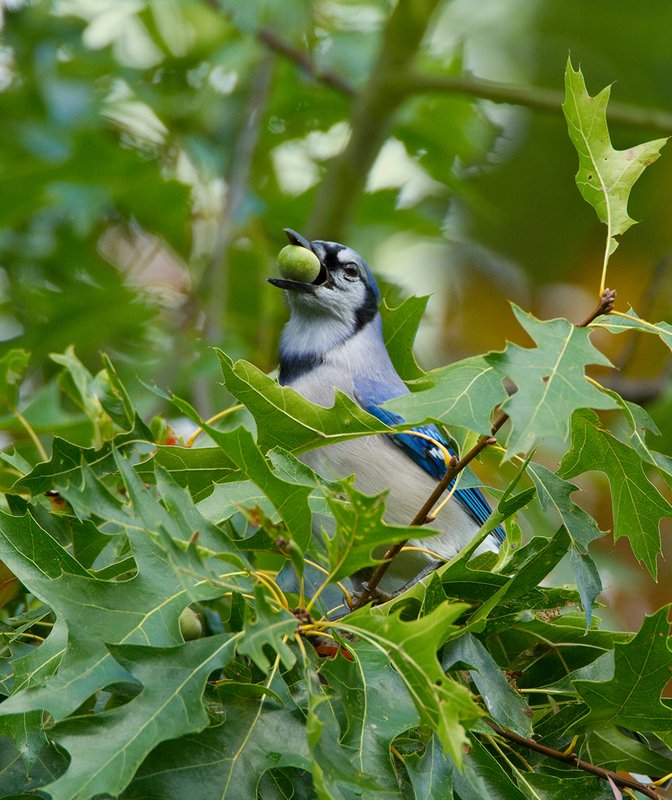
Oaks
Quercus sp.

Native oaks play an immensely important role in the ecosystem. In spring they support a vast diversity of insects and their larvae, which provide vital food for birds to feed their young in the nest and after fledging. In fall, the acorns are eaten and stored by jays, woodpeckers, titmice, nuthatches, Wild Turkeys and Wood Ducks, as well as mammals such as squirrels and deer.
Beginning in late September, Blue Jays begin gathering numerous acorns, flying off to bury them one at a time in the soil to provide a winter food resource. Jays play an important role in forest regeneration: while they remember the locations of many of their acorns, those they forget may germinate and become new oak trees.
Because of their size, longevity, and hard wood, oaks often symbolize resilience and stability in many cultures. In Germanic and Northern European folklore, the oak became closely associated with the concept of a life-sustaining sacred tree connected to the god Thor. Sacred oaks have often been gathering places and symbols of life, protection, and continuity.
In 2004 the oak was officially declared the national tree of the United States.