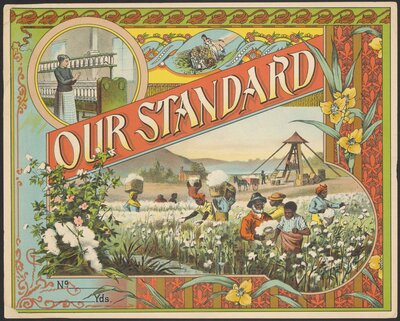
A cloth label that would have been affixed to the bolts of cotton fabric that came from the mills shows the source of the labor that produced the raw cotton - enslaved people on Southern plantations. It also portrays the final production of that cotton by white female laborers in Northern mills. The use of images of enslaved labor in advertising and publicity materials was not uncommon, well into the 20th century.
On loan from the Kheel Center for Labor-Management Documentation & Archives
This copy was originally owned by a formerly enslaved woman, Mrs. Annie Greene, who, according to the inscription, became a fashion writer in Buffalo, New York from 1890-1940. As most enslaved women were forbidden to read or own a book, Greene likely treasured this source, as it gave her not only access to vibrant illustrations and descriptions, but inspiration that drove her own economic mobility.
Marryat explains that the young nation’s leading figures, such as Thomas Jefferson and a number of other politicians, owned children they had with enslaved women.
Christy argued that immediate abolition remained an impossibility because of the moral inferiority of people of African descent and the global dependence on cotton. He referred to the abolitionist movement as “fruitless warfare” and championed the colonization movement, which focused on the relocation of free Black people.
Swatches were sent to Lewis Tappen along with the note, “Our sales of the B. Canton negro cloth altho confined to the Southern States and a new article have been large, say 100 Bales in 3 months of goods worth from 35 to 37/100.”
On loan from the Kheel Center for Labor-Management Documentation & Archives
In ledgers such as this, planters recorded details about the weather, the supplies used, and the work that enslaved laborers performed every day. These account books serve as a testament to the extensive and exploitative enterprise of cotton agriculture.